Stitch, Screen Print, Repeat: The Story Behind LaPac Boys' Merch Empire
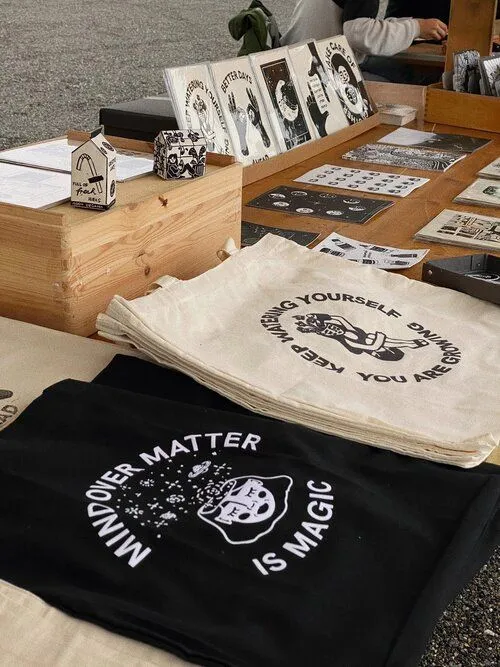
Photo: independent music merch table streetwear screen printing creative studio, via i.pinimg.com
If you've ever spotted someone rocking a faded LaPac Boys tee at a farmers market in Austin or a streetwear pop-up in Brooklyn, you already know — their merch hits different. It's not just a band shirt. It's a whole vibe, a signal to other fans that says you get it. But how exactly did a collective that started playing parking lot cyphers end up with one of the most talked-about merch cultures in independent music? We dug in.
More Than a T-Shirt Drop
Let's be real: most artist merch is an afterthought. You slap a logo on a Gildan tee, sell it at the merch table for $30, and call it a day. LaPac Boys never went that route. From early on, the collective treated merchandise as an extension of their creative identity — something that had to feel as intentional as the music itself.
"We were always asking, 'Would we actually wear this?'" says a longtime collaborator who helped design some of the collective's earliest pieces. "If the answer was no, it didn't make the cut. Simple as that."
That philosophy shows up in everything from the weight of the fabric they choose to the placement of graphics on a hoodie. Nothing is accidental. Even the color palettes — earthy tones, washed-out blues, the occasional burst of bold orange — tie back to the visual language the LaPac Boys have been building since day one.
Limited Drops That Actually Mean Something
One of the smartest moves LaPac Boys made early on was embracing the limited-drop model before it became the default play for every artist with a Shopify store. Their releases aren't just limited in quantity — they're tied to moments. A tour run. A studio session milestone. A collab with a local artist from whatever city they're passing through.
That contextual approach makes each piece feel like a collectible rather than inventory. Fans aren't just buying a hoodie; they're buying a piece of a specific chapter in the LaPac Boys story. And because quantities are genuinely limited — not artificially scarce in a cynical way — the secondary market for their gear has developed its own quiet energy. You'll find their older drops listed on Depop and Grailed for two or three times retail, and buyers are happy to pay it.
The Collab Game: Keeping It Local, Keeping It Real
What really separates LaPac Boys from the typical artist-merch playbook is their approach to collaborations. While plenty of acts go chasing big-name brand deals, LaPac Boys have consistently leaned into partnerships with independent designers, regional streetwear labels, and local artisans.
One designer who worked with the collective on a capsule collection for their Midwest run describes the process as unusually collaborative. "They came in with references, with mood boards, with ideas — but they were also genuinely curious about what I brought to the table," she explains. "It wasn't a situation where I was just executing their vision. It was a real creative conversation."
That spirit of mutual respect has made LaPac Boys a sought-after partner in creative circles. Brands know that a collaboration with them carries credibility — not just reach. And for fans, seeing the collective lift up independent designers they might not have discovered otherwise deepens the sense that LaPac Boys are genuinely invested in the communities around them.
Fan Loyalty That Goes Beyond a Points System
LaPac Boys have also built something rarer than a good merch table: actual fan loyalty infrastructure. Their inner-circle community — accessible through their website and social channels — gives dedicated fans early access to drops, behind-the-scenes content, and occasionally the chance to weigh in on creative decisions. It's low-key, but it works.
"They make you feel like you're part of something," one longtime fan from Chicago told us. "When a new drop goes live and you already knew it was coming because you're plugged in, that feels good. It's not just transactional."
That sense of belonging is hard to manufacture and even harder to sustain. LaPac Boys manage it because the loyalty program doesn't feel like a loyalty program — it feels like a fan club in the best, most genuine sense of the word.
Staying Authentic While Scaling Up
Here's the tension that every independent act faces when their merch starts selling: how do you grow without losing the thing that made people care in the first place? For LaPac Boys, the answer seems to be staying close to the creative process and being selective about who they partner with.
They've turned down deals. That's not a rumor — collaborators have confirmed it. Offers from brands that didn't align with their aesthetic or values got a polite pass, even when the money was real. In an era where artists routinely license their name to energy drinks and fast fashion lines, that restraint is notable.
It also pays off in the long run. The LaPac Boys brand carries weight precisely because it hasn't been diluted. When they do announce a collab or a new drop, the audience pays attention — because they know it's going to be worth it.
What the Merch Culture Tells Us About the Music
Ultimately, the LaPac Boys merch story is really a story about artistic integrity and how it compounds over time. Every thoughtful design choice, every locally-rooted collaboration, every limited drop tied to a real moment — it all reinforces what the music is already saying. This is a collective that takes their craft seriously, from the studio to the storefront.
For fans, that coherence is part of the appeal. You're not just buying into a sound. You're buying into a worldview. And that's something no major label marketing budget can replicate.